
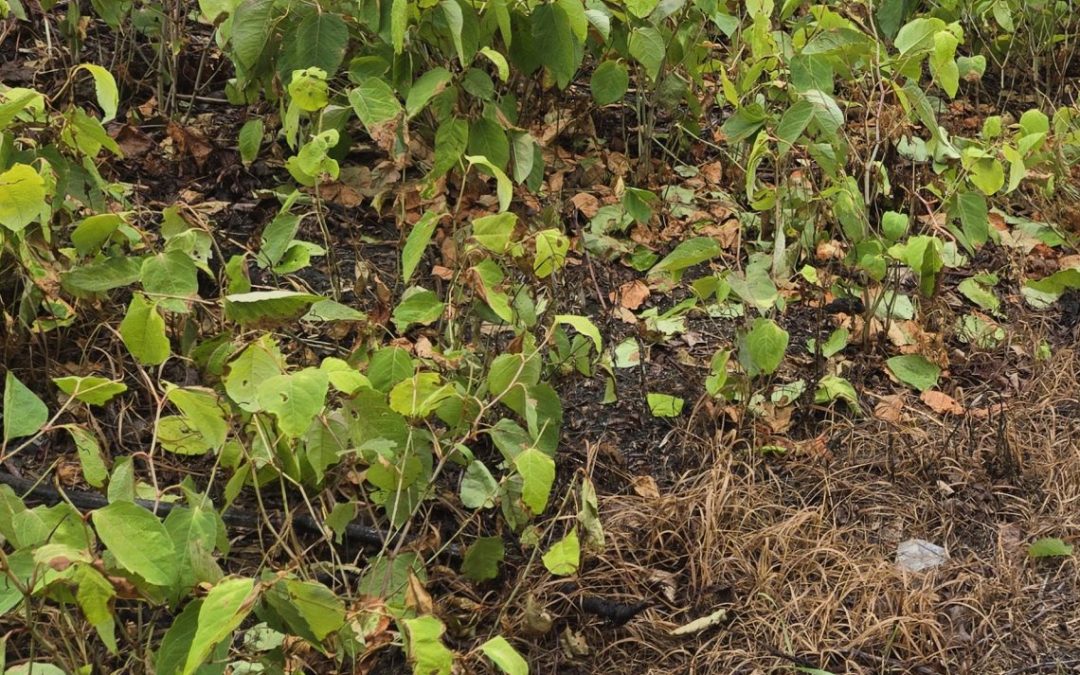
If you’ve ever tried to control Japanese knotweed, you already know the frustration. You treat it, the foliage browns, the stalks decline, and it looks like you’re finally winning—only to see new shoots emerge again.
At MHI Solutions, we’ve experienced this firsthand. And we’re certainly not alone. Japanese knotweed is considered one of the more difficult invasive plants to manage because what we see above ground represents only part of the problem. The real battle is happening below the surface.
The Rhizome Is the Problem
Japanese knotweed develops an extensive underground rhizome system that stores energy and allows the plant to regenerate after the visible vegetation has been damaged or removed. That means killing the leaves and stalks does not necessarily mean the plant is dead.
A treatment can produce significant above-ground injury while portions of the rhizome system remain viable. Those underground reserves can then produce new shoots sometimes making a treatment that initially looked successful feel like a failure. This is one of the most important lessons with knotweed:
Visible injury is not the same as long-term control.
Timing Matters
One of the strongest treatment windows for established Japanese knotweed is late summer through early fall while the foliage is still healthy and actively growing. Why?
As the growing season begins winding down, the plant starts moving carbohydrates produced in the leaves down into its crowns and rhizomes for storage. A properly timed systemic herbicide treatment takes advantage of that natural movement. Instead of simply damaging the foliage, the goal is to have the herbicide absorbed through healthy leaves and translocated deeper into the plant. This is why fall treatment can be so valuable. It is also why mowing or cutting immediately before treatment can work against you. Removing too much healthy leaf area removes the very surface needed to absorb and move a systemic herbicide through the plant.
Why One Treatment Often Isn’t Enough
With a mature knotweed stand, eradication should not be viewed as a single application. The underground system may have developed over many years. Even after a strong treatment, surviving rhizomes may have enough stored energy to send up additional shoots. Those shoots aren’t necessarily evidence that nothing worked. What matters is what happens to the stand over time.
- Are there fewer stems?
- Are the stems smaller?
- Is the stand becoming less dense?
- Is the treated area shrinking?
- Are previously vigorous plants returning weak and stunted?
Those changes help tell the real story of whether the rhizome system is being depleted.
Cutting Can Help or Hurt
Mowing and cutting have a place in an Integrated Pest Management program, but timing is critical. Repeated cutting can reduce the plant’s ability to replenish its underground energy reserves, but cutting alone rarely solves an established knotweed problem. Cutting at the wrong time can also interfere with herbicide treatment by removing the foliage necessary for absorption.
There is another concern: knotweed can regenerate from plant material, which means careless movement of cut vegetation can contribute to its spread. The mowing schedule and herbicide schedule therefore need to work together rather than operate as two separate activities.
What We’ve Learned in the Field
Our experience at MHI has reinforced that successful knotweed management requires patience. We’ve seen areas respond quickly and others continue producing growth despite substantial injury from previous treatments. That can be frustrating for the contractor and the property owner, but knotweed management has to be evaluated over seasons—not simply by what the site looks like a few weeks after an application.
The objective is to continually reduce the plant’s ability to rebuild its underground reserves. That requires the right treatment timing, adequate healthy foliage, proper application, appropriate mowing practices and, most importantly, follow-up.
Spring Is for Assessment, Fall Is for the Bigger Hit
Spring regrowth provides valuable information. It shows us where the rhizome system survived, how aggressively the stand is returning and where follow-up treatment needs to be concentrated. Rather than expecting every surviving shoot to disappear immediately, spring and early summer can be used to monitor the response and manage growth strategically. Then, as the plant develops sufficient healthy foliage and approaches the late-summer/fall translocation period, treatment can be timed to take advantage of the plant’s own biology.
Control Is a Process
There is no magic one-treatment solution for a well-established knotweed infestation. Successful management is usually a process of treatment, observation, regrowth assessment and retreatment.
For MHI, that means documenting what we see in the field and adjusting the management plan based on the plant’s response rather than simply repeating the same treatment because it was used the year before. A successful program may take multiple growing seasons. And success shouldn’t only be measured by whether every stalk disappears after the first treatment. A shrinking stand, weaker regrowth, fewer stems and reduced density are all indicators that pressure on the underground rhizome system is working.
Japanese knotweed may be persistent.
Our management plan has to be more persistent.